• ABOUT US
  • OUR HISTORY
  • OUR MISSION, OBJECTIVES & ENDORSED BILLS
  • COALITION MEMBERS
  • COALITION LEADERSHIP
  • CONTACT US
  • RECEIVE UPDATES
Stop Child Labor - The Child Labor Coalition
  • NEWS & RESOURCES
    • Viewpoints
    • News & Events
    • 10 Facts About…
    • Reports
    • Timeline
    • Social Media
  • CHILD LABOR – US
    • In Our Products
      • Chocolate
      • Cotton
      • Clothes
      • Electronics
      • Gold
      • Tin
    • In Our Fields
      • Children in Agriculture
      • Children in the Fields Campaign
      • CARE Act
    • Legislation
    • Youth Employment
      • Young Worker Deaths & Injuries
      • Youth Peddling Crews
    • Enforcement–US
    • Trafficking–US
    • U.S. DOL
    • US Child Labor Laws
      • Federal Laws
      • State Laws
    • Corporations and Child Labor
    • US Campaigns
  • CHILD LABOR – INTERNATIONAL
    • Agriculture
      • Chocolate
      • Cotton
      • Tobacco
    • Industry/Products
      • Clothing
      • Construction
      • Electronic Equipment
      • Mining
      • Other Products
      • Rubber
      • Rugs
      • Seafood
      • Soccer Balls
      • Tobacco
    • Countries
      • African Countries
      • Angola
      • Botswana
      • Burkina Faso
      • Central African Republic
      • Chad
      • Cote d’Ivoire
      • Democratic Republic of the Congo (DRC)
      • Egypt
    • Child Soldiers
    • Trafficking (International)
    • Forced Labor/Slavery
    • Education & Child Labor
    • International Initiatives
      • Convention on the Rights of the Child
      • Global Campaign for Education
  • TAKE ACTION
    • Donate
    • Child Labor Tools for Consumers–Apps
  • DONATE
  • Search
  • Menu Menu

Tag Archive for: Tobacco

thumbnail

Report Traces Goods Made with Child Labor to 76 Countries

September 26, 2018/in Gold, U.S. DOL, Viewpoints/by CLC Member

Jo Becker, advocacy director, Children’s Rights Division, Human Rights Watch

Of the products we use, wear, or consume every day, how many are made with child labor? Perhaps quite a few. A new report from the US Department of Labor* identifies 148 different consumer goods produced with child or forced labor around the world. The list includes clothing, beef, sugar, bricks, coffee, and other products originating from 76 countries.

Gold tops the list. The report found that in at least 21 countries, children help mine gold, climbing into unstable shafts, carrying and crushing heavy loads of ore, and often using toxic mercury to process the gold. My colleagues and I have seen how dangerous this work can be, documenting the risks child miners face in Ghana, Philippines, Tanzania, and Mali.

Tobacco produced with child labor originates from at least 16 countries, placing it in the report’s top five. Child tobacco workers often labor in extreme heat, are exposed to dangerous pesticides, and risk nicotine poisoning from handling tobacco plants. In our investigations, children in the United States, Indonesia, and Zimbabwe have described nausea, vomiting, headaches, and dizziness while working in tobacco fields.

Governments, companies, and consumers share responsibility to end child labor. Governments should monitor and enforce their labor laws and provide children with good-quality, free education.

For children old enough to work, both governments and companies should ensure their jobs do not risk anyone’s health or safety. Companies should also monitor their supply chains, report on their efforts, and when child labor is found, transition these children to school or safe alternatives. Our report on the jewelry industry outlines steps companies should take.

Consumers can ask retailers and manufacturers about their child labor policies and practices.

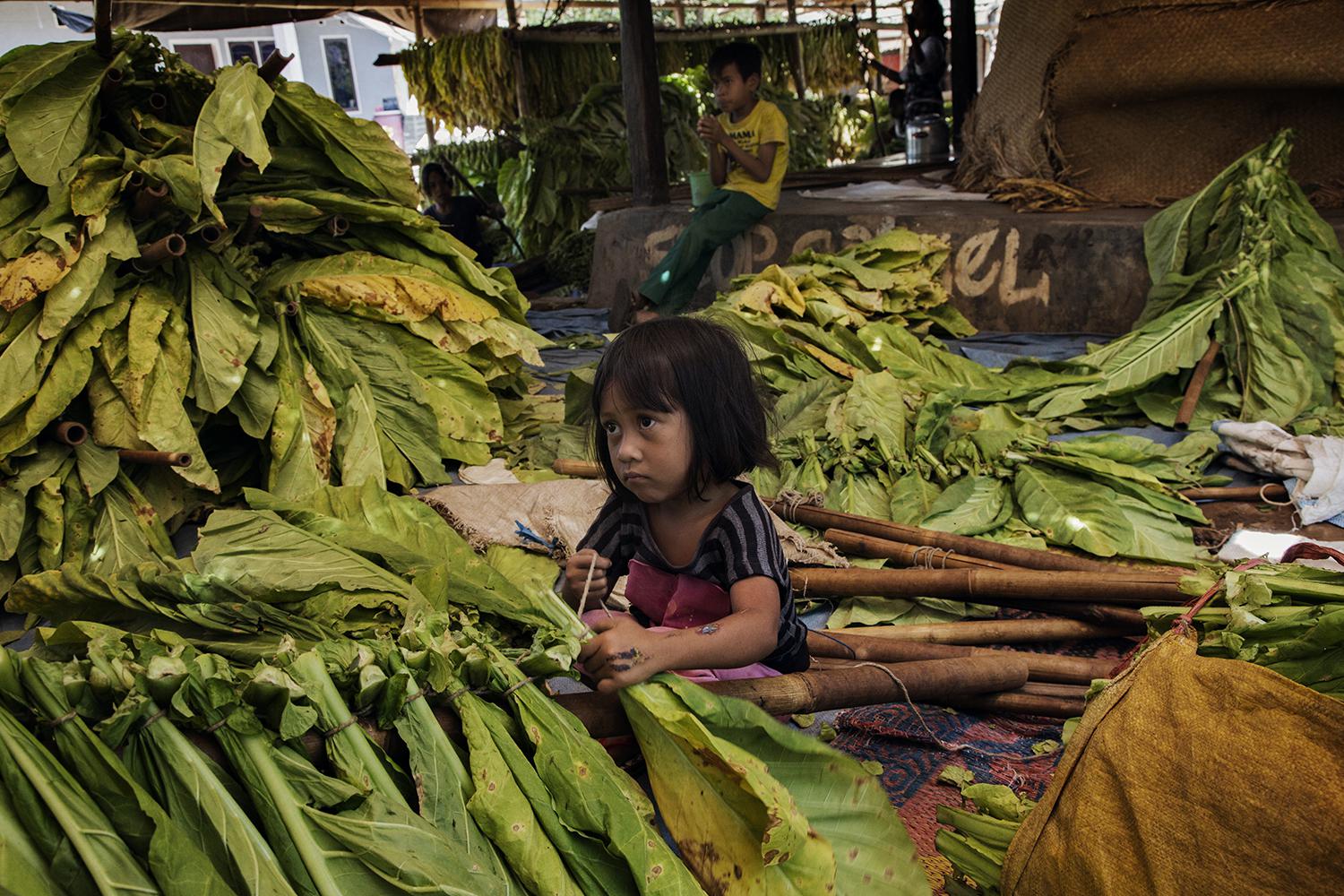
A young girl ties tobacco leaves onto sticks to prepare them for curing in East Lombok, West Nusa Tenggara.

A young girl ties tobacco leaves onto sticks to prepare them for curing in East Lombok, West Nusa Tenggara, Indonesia.

© 2015 Marcus Bleasdale for Human Rights Watch

Ending child labor is possible. Since 2000, the number of children involved in it has dropped by a third ‒ from 245 million to 152 million. In the last two years, the Department of Labor found that 17 governments have made “significant” advancement in ending child labor, and another 60 have made “moderate” advancements. It noted particular progress in ending child labor in Panama’s sugar production, and cotton harvesting in Paraguay and Uzbekistan.

Still, we have a long way to go. Products that are part of our daily lives shouldn’t come at the expense of children’s health, safety, and education.

[Originally published at www.hrw.org on September 21, 2018 1:35PM]
Jo Becker is the advocacy director of the Children’s Rights Division at Human Rights Watch, which is a member of the Child Labor Coalition.
*Links are no longer active as the original sources have removed the content, sometimes due to federal website changes or restructurings
https://stopchildlabor.org/wp-content/uploads/2022/08/logo.png 0 0 CLC Member https://stopchildlabor.org/wp-content/uploads/2022/08/logo.png CLC Member2018-09-26 13:00:172026-06-16 19:01:23Report Traces Goods Made with Child Labor to 76 Countries
thumbnail

American 12-Year-Olds Can’t Buy Cigarettes. Why Can They Work in Tobacco Fields?

July 11, 2018/in Children in Agriculture, Children in the Fields Campaign, Viewpoints/by Reid Maki

[This op-ed appeared in The Guardian on June 28, 2018. You may view it there by clicking here.]

It’s no surprise that working in tobacco fields is dangerous. Smoking tobacco kills 6 to 7 million people a year, according to the World Health Organization. The same nicotine that makes tobacco so dangerous – and addictive – harms workers in tobacco fields. What is a surprise to many is that child workers are among those harmed and the United States allows 12-year-olds to work for wages in toxic tobacco fields where children are exposed to nicotine and toxic pesticides.

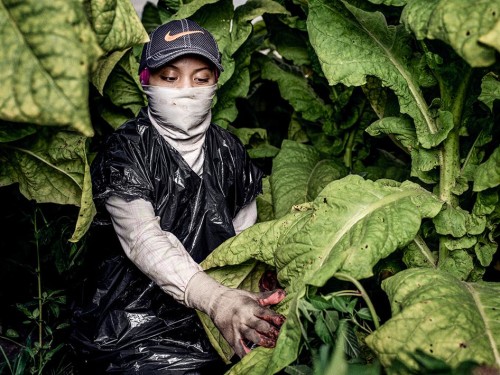
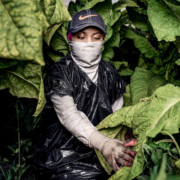
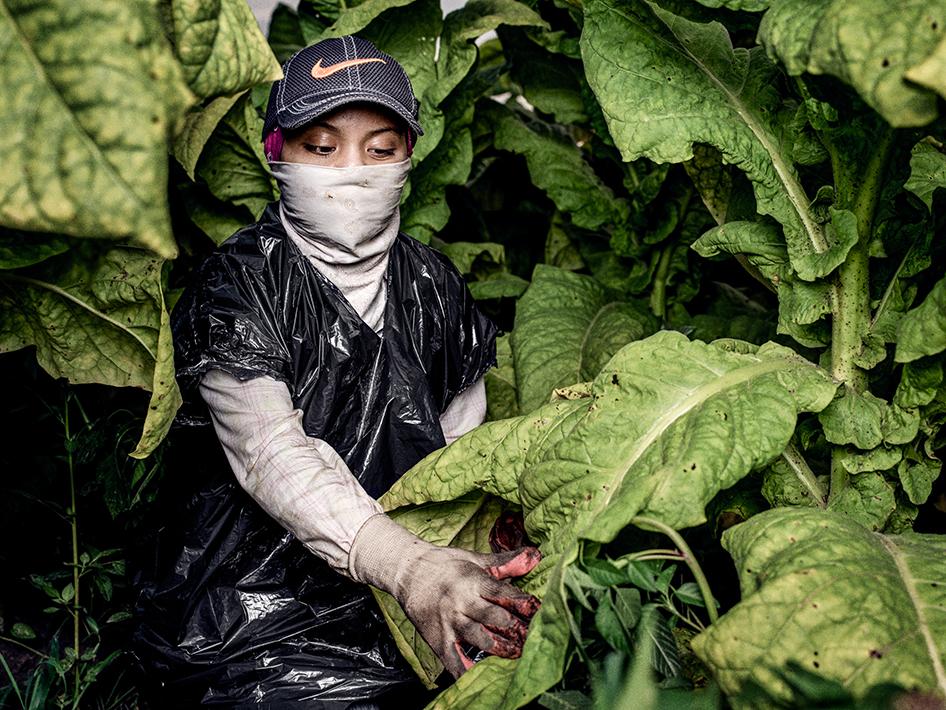
In the U.S., many teens who work in tobacco fields wear plastic garbage bags to try to avoid nicotine poisoning. [Photo courtesy Human Rights Watch]

When the seminal legislation the Fair Labor Standards Act was passed in 1938, it exempted agriculture from its extensive labor protections, including child labor. Most analysts agree that racism played a part in this decision – many agricultural workers were poor black people and the southern congressional leaders who controlled many committees had little interest in protecting them from labor abuses.

Human Rights Watch (HRW), whom we partner with on the US-based Child Labor Coalition, has confirmed that tobacco work is too dangerous for teen workers. Its 2014 report, Tobacco’s Hidden Children: Hazardous Child Labor in United States Tobacco Farming, featured the results of interviews of 140 child tobacco workers and found the majority had suffered symptoms that correlated with frequent bouts of “green tobacco sickness” – essentially nicotine poisoning.

The child laborers described nausea, dizziness, fatigue and other symptoms that left them feeling “like you’re going to die”. It’s clear that children absorb nicotine while they work from residue on tobacco leaves and from particulates in the air, but just how much is uncertain. Estimates differ from the equivalent of smoking six cigarettes a day to smoking over 30. The long-term impact of that absorption is not yet known.

In the US, a 12-year-old cannot legally walk into a store and buy cigarettes, but the law allows that same child to work in a tobacco field. A 16-year-old child tobacco worker told HRW that tobacco was “the hardest of all the crops we’ve worked in. You get tired. It takes the energy out of you. You get sick, but then you have to go right back to the tobacco the next day.”

Read more

https://stopchildlabor.org/wp-content/uploads/2022/08/logo.png 0 0 Reid Maki https://stopchildlabor.org/wp-content/uploads/2022/08/logo.png Reid Maki2018-07-11 18:27:332022-11-07 06:11:02American 12-Year-Olds Can’t Buy Cigarettes. Why Can They Work in Tobacco Fields?
thumbnail

CLC News Release: Legislation to Protect Child Farmworkers in the US is Re-Introduced

July 17, 2017/in CARE Act, Children in Agriculture, Children in the Fields Campaign, In Our Fields, Legislation, News & Events, Viewpoints/by Reid Maki

CHILD LABOR COALITION PRESS RELEASE
Child Labor Coalition applauds the introduction of two congressional bills to reduce dangerous child labor in U.S. agriculture

For immediate release: June 13, 2017
Contact: Reid Maki, (202) 207-2820, reidm@nclnet.org

Washington, DC—The Child Labor Coalition (CLC) and its 35 members applaud the re-introduction late yesterday of two congressional bills that would significantly reduce child labor in U.S. agriculture and largely equalize child labor laws for wage-earning children on farms with current rules for non-farm work.

In the U.S., many teens who work in tobacco fields wear plastic garbage bags to try to avoid nicotine poisoning. [Photo courtesy Human Rights Watch]

In the U.S., many teens who work in tobacco fields wear plastic garbage bags to try to avoid nicotine poisoning. [Photo courtesy Human Rights Watch]

In the House of Representatives, Rep. Roybal-Allard (D-CA) re-introduced the Children’s Act for Responsible Employment (CARE), which would amend the Fair Labor Standards Act, removing the exemptions that prevent the nation’s child labor laws from applying to children who work for wages on farms.

“A 12-year-old is not allowed to work in our air-conditioned office,” said Sally Greenberg, executive director of the National Consumers League and a co-chair of the CLC. “Yet, that same child is allowed to work unlimited hours, seven days a week on a farm, performing back-breaking work.”

CARE would also raise the age at which children laboring on farms can perform hazardous work from 16 to 18, which is the norm for all non-farm work. “We lose far too many children to work accidents on farms,” said CLC Coordinator Reid Maki. “This change is long overdue.”

“Child farmworkers work at far younger ages, for longer hours, and under more hazardous conditions than children are allowed to work in any other industry. It’s time to end this double standard in U.S. law and ensure they have the same protections as other working youth,” said CLC-member Jo Becker, children’s rights advocacy director for Human Rights Watch.

Read more

https://stopchildlabor.org/wp-content/uploads/2022/08/logo.png 0 0 Reid Maki https://stopchildlabor.org/wp-content/uploads/2022/08/logo.png Reid Maki2017-07-17 12:28:122022-11-17 05:55:49CLC News Release: Legislation to Protect Child Farmworkers in the US is Re-Introduced
thumbnail

Rep. Cicilline and 46 Members of Congress Ask President Obama to Ban Child Labor in US Tobacco

October 18, 2016/in Children in Agriculture, Children in the Fields Campaign, News & Events, Viewpoints/by Reid Maki

October 18, 2016


The President

The White House

1600 Pennsylvania Avenue, NW

Washington, DC 20500


Dear Mr. President:

As you approach the final months of your term in office, we would first like to commend you on the Strides your administration has made in combatting the dangers that tobacco and nicotine products pose to children. With those accomplishments in mind, we ask that you take immediate action to amend existing rules which allow children under the age of 18 to do dangerous work on tobacco farms. The hazards to children associated with this type of labor make closing this loophole essential.

Current U.S. law allows children as young as 12, or even younger, to work as hired laborers in agriculture, and there is no special provision in law or regulation which accounts for the unique risks to children who work in tobacco fields. According to detailed reports published by Human Rights Watch in 2014 and 2015, children allowed to work on tobacco farms often work excruciatingly long hours in harsh conditions, and often without protective gear. They routinely handle tobacco plants containing nicotine, and many of these children experience symptoms such as nausea, Vomiting, and dizziness- which are consistent with acute nicotine poisoning, an occupational illness that occurs when workers absorb nicotine through their skin. The long-term impacts on children are unknown, but research on Smoking suggests nicotine exposure during childhood and adolescence may have lasting consequences on brain development.

Because of this, it is critical that the Department of Labor issue a new rule specifically identifying labor in tobacco fields as hazardous and prohibiting children from working in direct contact with tobacco in any form. In order to avoid placing an undue burden on family farms, the rule need only apply to farms using hired laborers. Additionally, such a rule would be met with Support among many in the tobacco industry as many companies have already taken Steps to combat child labor practices. U.S. companies such as Altria Group and Reynolds American have Voluntarily prohibited their suppliers from employing children under the age of 16. These important steps made by industry should be met with strong action by the Department of Labor.

Read more

https://stopchildlabor.org/wp-content/uploads/2022/08/logo.png 0 0 Reid Maki https://stopchildlabor.org/wp-content/uploads/2022/08/logo.png Reid Maki2016-10-18 13:12:452022-11-17 05:55:49Rep. Cicilline and 46 Members of Congress Ask President Obama to Ban Child Labor in US Tobacco
thumbnail

Antonement and Action for President Obama in His Last 100 Days

October 10, 2016/in Children in the Fields Campaign, Convention on the Rights of the Child, News & Events, Viewpoints/by Reid Maki
Jonathan Todres

Jonathan Todres

By Jonathan Todres


This week is Yom Kippur (Sundown, October 11 to Sundown, October 12), the Day of Atonement on the Jewish calendar. As tradition has it, atoning on Yom Kippur will address only sins against God. For transgressions against other individuals, Jews are obligated to seek forgiveness from and reconciliation with those people first. Yom Kippur also marks the end of the High Holidays, and thus offers the prospects of a fresh start and an opportunity to do better than we did the year before.


While I’m well aware that President Obama is not Jewish (or Muslim—are people still really talking about that?), I’d like to invite him to participate, at least in spirit.  And I think the timing is appropriate, because Yom Kippur falls approximately 100 days from the end of the Obama Presidency—leaving one final window of opportunity for the president while still in the Oval Office.


On his inauguration in 2009, newly-elected President Obama boldly proclaimed that “[a]s for our common defense, we reject as false the choice between our safety and our ideals.” Human rights advocates hailed his election and speech as the dawn of a new, promising era of progress on human rights. The past eight years haven’t necessarily lived up to expectations.


So, with little more than 100 days left in the Obama Presidency, I have two hopes. First is that he is reflecting on shortcomings (e.g., no human rights treaty was ratified while he was in office; even President George W. Bush managed to achieve ratification of two human rights treaties). Second is that he will use these final 100 days to do better.  Yes, I know he faces significant opposition in the Senate (the Senate’s failure to approve the Convention on the Rights of Persons with Disabilities was deeply disappointing). But at the risk of sounding naïve, if you aren’t willing to try to advance the ball on human rights when holding arguably the most powerful position in the world, when is the right time?


The “To Do List” for human rights is lengthy. But here are three options for President Obama that can be done within 100 days:


  1. End the federal government practice of confining migrant children in detention centers. No six-year-old who has fled violence in search of safety should be “welcomed” by being incarcerated. A recent essay by Wendy Cervantes at First Focus sheds light on this practice.


  1. Ban child labor in tobacco production. The adverse health consequences of tobacco use are well known. Less well-known is the harm inflicted on those who work in tobacco fields, particularly children. In August 2016, 110 organizations called on President Obama to protect children from “acute nicotine poisoning and other health and safety hazards faced by children working in US tobacco fields.” (click here for the letter to President Obama from the Child Labor Coalition and other organizations).


  1. 3. Send the Convention on the Rights of the Child (CRC) to the Senate. The U.S. is now the only country in the world that has not ratified the CRC. This is the closest any human rights treaty has come to universal acceptance. Since the U.S. signed the treaty in 1995, no President has taken further action. No one can prevent President Obama from forwarding the treaty to the Senate for its advice and consent. Are there sufficient votes in the Senate now for ratification? Probably not. Might some Senators object? Probably.  But it’s President Obama’s decision, and sending the treaty to the Senate would be a step forward.


These three opportunities all have two important things in common: First, President Obama has the power to act on all of these. Second, all three steps would help move the United States in direction of ensuring the rights and well-being of children. It’s time for action.


Jonathan Todres is a Professor of Law, Georgia State University College of Law, who has been collaborating with the Child Labor Coalition in the Campaign for the US Ratification of the Convention on the Rights of the Child.

https://stopchildlabor.org/wp-content/uploads/2022/08/logo.png 0 0 Reid Maki https://stopchildlabor.org/wp-content/uploads/2022/08/logo.png Reid Maki2016-10-10 12:27:032022-11-17 05:55:49Antonement and Action for President Obama in His Last 100 Days
thumbnail

110 Groups Urge President Obama to Ban Child Labor in US Tobacco

August 3, 2016/in Children in Agriculture, News & Events, Viewpoints/by Reid Maki

August 3, 2016

President Barack Obama
The White House
1600 Pennsylvania Avenue
Washington DC 20500

Dear Mr. President,

In August 2014, dozens of organizations counting millions of Americans among their members wrote to you, alarmed at reports of acute nicotine poisoning and other health and safety hazards faced by children working in US tobacco fields. We are writing again regarding measures you should take to protect these vulnerable children before you leave office in January 2017.

On May 5, the FDA announced new regulations prohibiting the sale of e-cigarettes to children under the age of 18. In announcing the new regulations, the Secretary of Health and Human Services stated, “We’ve agreed for many years that nicotine does not belong in the hands of children.” We agree. Yet US law allows children as young as 12, and in some cases even younger, to work in direct contact with tobacco in US tobacco fields and curing barns. There are no regulations or special provisions in place to protect child tobacco workers from exposure to nicotine and awareness raising efforts have limited effect given that the extreme poverty many tobacco farming families experience is the principle reason these children work in the tobacco fields at all.

201512_crd_us_tobacco_photo_2The health risks tobacco farm workers face are considerable, leaving workers vulnerable to heat stroke and green tobacco sickness. The majority of these workers are seasonal/migrant workers who have little access to mechanisms that would hold growers accountable for conditions in the fields, and often few options but to bring children to work. The health consequences of tobacco work are worse for children than they are for adults, because children’s smaller bodies absorb proportionately more nicotine than adults. There are long-term developmental repercussions as well. Children who work in direct contact with tobacco leaves risk acute nicotine poisoning, and may experience symptoms including vomiting, nausea, headaches and dizziness. A widely-reported 2014 study by Human Rights Watch found that the majority of the 141 child tobacco workers interviewed had experienced the sudden onset of symptoms consistent with nicotine poisoning while working in fields of tobacco plants and curing barns in North Carolina, Kentucky, Tennessee and Virginia.

Public health research has found that non-smoking adult tobacco workers have similar levels of nicotine in their bodies as smokers in the general population. Although the long-term effects of nicotine absorption through the skin have not been studied, research on smoking finds that nicotine exposure during adolescence has been associated with mood disorders and problems with memory, attention, impulse control, and cognition later in life.

In the last two years, both U.S. tobacco growers’ associations and major companies in the tobacco industry have made some progress in acknowledging that children should not be working on tobacco farms. The Tobacco Growers Association of North Carolina and the Council for Burley Tobacco, which collectively represent approximately half of all US tobacco growers, have adopted policies stating that children under age 16 should not be hired to work on tobacco farms. The two largest US-based tobacco companies, Altria Group and Reynolds American, now prohibit their suppliers from employing children under the age of 16. Companies including Philip Morris International have publicly called for US regulatory action to back up these voluntary commitments.

The safety and health of child tobacco workers is just as important as teens who may be tempted by e-cigarettes. We urge you to take immediate action to protect these vulnerable children, through the following:

1) Immediate regulations to ban children from working in direct contact with tobacco: A critical first step the administration can take to protect child tobacco workers is for the Department of Labor (DOL) to issue a hazardous occupation order that specifically prohibits children from working in direct contact with tobacco. In 2011 the DOL issued proposed regulations to update the list of tasks too dangerous for children under age 16 employed in agriculture, including “all work in tobacco production and curing, including, but not limited to such activities as planting, cultivating, topping, harvesting, baling, barning, and curing.” Intense opposition to the regulations mischaracterized them as applying to family farms and focused on specific elements, including the use of tractors and certain tools. In 2012, the administration withdrew the proposed regulations.

Read more

https://stopchildlabor.org/wp-content/uploads/2022/08/logo.png 0 0 Reid Maki https://stopchildlabor.org/wp-content/uploads/2022/08/logo.png Reid Maki2016-08-03 13:13:322022-11-17 05:55:49110 Groups Urge President Obama to Ban Child Labor in US Tobacco
thumbnail

Len Morris: Our Kids Are Watching Us

August 2, 2016/in CARE Act, Children in Agriculture, Viewpoints/by CLC Member

For the first time in more than a year, Democrats and Republicans have begun to speak mistily about the prospects for our children’s future.

“With every word we utter, with every action we take, we know our kids are watching us. Kids look to us to determine who and what they can be.”       –Michelle Obama

Words alone don’t matter. What actions can the Congress and President take immediately to improve the lives of American children?

Human Rights Watch has reported extensively on health hazards of children working in the American Tobacco Industry. Voluntary policies to eliminate child labor in tobacco are insufficient and carry no force of law. The Children Don’t Belong on Tobacco Farms Act (S.974/H.R.1848) should be passed by Congress and signed into law. The medical evidence is overwhelming; children have no business handling tobacco. This bill should take five minutes to pass, about the same amount of time it takes to read. Pass this Bill now, in the lame duck Congressional session in September.

CLC-member Len Morris of Media Voices for Children

CLC-member Len Morris of Media Voices for Children

If we’re going to protect children in the fields who pick tobacco, why not protect all children who work in American agriculture whose lives and educations are put on hold and whose health is compromised by 12-hour days of work in one of the most dangerous occupations in the country? The Children’s Care Act for Responsible Employment (HR2764) has had the support of over a hundred national organizations and dozens of House members but has failed to find a single United States Senator willing to champion them by sponsoring legislation in the Senate. And so every day, in every state of our union, hundreds of thousands of children pick our fruits and vegetables, exposed to pesticides. With a 60% drop-out rate from school, they are utterly poor and equally vulnerable… a target for human traffickers.

After 80 years of delay, it’s long past time for the Congress and President to amend the 1939 law that ended child labor in America. Adults should work in the fields and make a living wage; children belong in school. It’s time for The Care Act to be sponsored in the Senate so this legislation has an opportunity to pass. Why wait – what’s to be gained by more delay? Do this in September.


Over 65,000 young people, who were brought as children to this country by their parents in search of a better life, live each year in the shadow of deportation and are unable enroll in school, find work or pursue normal lives. For years, Congress has failed to pass multiple versions of The Dream Act, a bipartisan supported Bill that would enable Dreamers to qualify to remain in America, live and work and contribute to America, including service in our military. This bill is not an amnesty, it’s a pathway to legitimacy for young adults guilty only of being brought here as children.

While Congress talks itself to death, America loses out on the economic potential of some of our brightest children. One UCLA report found that Dreamers would add between 1.4 to 3.6 trillion dollars to the American economy during their work lives. The Congressional Budget Office sees the national deficit reduced by 1.4 billion dollars as the Bill reduces and focuses the costs of border security to those individuals who constitute a real and violent threat to our society. But mostly, The Dream Act is a simple test of American values. Can we put ourselves in the other person’s shoes? Can we find the empathy we need to make room at our table for children, who are in fact our schoolmates, our neighbors, our soldiers? Now is the time to pass the Dream Act because it’s the right thing to do for those children but for also ourselves, as an expression of our own humanity.

“We don’t chase fame and fortune for ourselves, we fight to give everyone a chance to succeed, because we always know there is someone who is worse off and there, but for the grace of God, go I.”

                                        –Michelle Obama

Children’s rights are human rights and human rights are children’s rights, that’s the point of the 1995 treaty, The Convention on the Rights of the Child. Every nation on earth, except the United States, has adopted the Convention, a landmark document of utter simplicity that sets out the kind of world we should all aspire to for all children. While President Clinton signed the Treaty in 1995, no American President has ever submitted it to the United States Senate for its required “advise and consent”. Over the years, objections to the Convention came from those upset that it prohibits either juvenile execution or life sentences, positions upheld by The United States Supreme Court. Home-school advocates have objected to the Convention’s requirement for mandatory public education. But the actual issue preventing adoption has always been American exceptionalism, the feeling that we shouldn’t agree to any treaty binding our behavior on the global stage.
U.S.+Child+Labor

President Obama, here is an easy addition to your legacy. Send this Convention on to the Senate and make a strong statement about children’s human rights. By doing the right thing, you’d re-energize the debate about the welfare of children around the world and at home. You’d set an example and force the Senate to look into its heart. With Somalia’s ratification last year, America has the distinction of being the ONLY country to not ratify The Convention on the Rights of the Child…. and what a distinction that is… to sit on the sidelines and pretend we care about values we’re unwilling to adopt and publicly support. If we mean what we say about championing children interests, then adopting the CRC is the right thing to do.

President Obama, don’t leave office without sending this Treaty on to the Senate. Do it now.Children sickened by tobacco, children working illegally in America’s fields, children whose lives are on hold and live threatened by deportation, a world where the value and rights of children are ignored by the greatest democracy on earth. Is this the world we want for our children?

“Words and actions matter… With every word we utter and every action we take, we know our kids are watching us. “Michelle Obama

Len Morris of Media Voices for Children received the Iqbal Masih Award from the Department of Labor in 2012 for his work to end the worst forms of child labor.

Read more

https://stopchildlabor.org/wp-content/uploads/2022/08/logo.png 0 0 CLC Member https://stopchildlabor.org/wp-content/uploads/2022/08/logo.png CLC Member2016-08-02 13:36:032022-11-07 06:10:59Len Morris: Our Kids Are Watching Us
thumbnail

Tobacco harvester — A five-most-dangerous job for teens

June 2, 2016/in Young Worker Deaths & Injuries, Youth Employment/by Reid Maki

 A 12-year-old cannot legally buy cigarettes in the U.S., but they are allowed to work in a tobacco field for 10- to 12- hours a day in 100-degree heat and suffer repeated bouts of nicotine poisoning. This is legal because of decades-old exemptions to U.S. child labor laws that apply to agriculture. Teen tobacco workers do not die at the highest rate, but they do feel as if they are dying in large numbers.
201512_crd_us_tobacco_photo_2

A Human Rights Watch (HRW) report, “Tobacco’s Hidden Children: Hazardous Child Labor in United States Tobacco Farming,” published in May 2014 found that three quarters of 141 child tobacco workers interviewed in North Carolina, Kentucky, Virginia and Tennessee—the main tobacco-producing states—reported getting sick while working on U.S. tobacco farms. Many of their symptoms—nausea, vomiting, loss of appetite, headaches, and dizziness—are consistent with acute nicotine poisoning (also known as “Green Tobacco Sickness”.) A frequent comment from child tobacco workers who experience this illness is, “I thought I was going to die.”

Child tobacco workers often use dangerous, sharp tools and can work in tobacco drying barns at heights without protective equipment as they balance precariously on the top of wood beams that may be only one or two inches thick.

In addition to nicotine, farmworker children may also be absorbing a range of toxic pesticides commonly used in tobacco fields. Children often wear black garbage bags to protect them from these dual exposures but you can imagine what it’s like to wear a plastic bag in the 90- and 100-degree temperatures often found in tobacco fields.

To make matters worse, Human Rights Watch found that three of the four states that produce 90 percent of US tobacco (Kentucky, Virginia, and Tennessee) have failed to take sufficient measures to enforce the Occupational Safety and Health Administration’s (OSHA) Field Sanitation Standard. This standard requires workers to be provided with fresh drinking water, hand washing facilities, and toilets. Most of the children interviewed by HRW were not provided with hand washing facilities or toilets, and some were not given sufficient drinking water.  The absence of hand washing facilities significantly increases the risks of nicotine and pesticide exposure.

Using information from the OSHA Integrated Management Information System, HRW reports that from January 2010 to December 2013: Kentucky carried out only eight field inspections in tobacco; Tennessee carried out one field inspection; and Virginia carried out none. Only one of the four major tobacco-producing states, North Carolina, made meaningful attempts to enforce the Field Sanitation Standard, with 143 inspections during the time period, said HRW researchers.

The situation, with children as young as 12 (and HRW found about a dozen kids conducting lighter work in the fields who were under 12), is so absurd that it proved to be great material for the satirists at “The Daily Show with Jon Stewart,” who produced an entertaining, but alarming, report called “Nicoteens.” The clip is comical and allows you to hear young tobacco workers describing the work conditions in their own words, but child labor in U.S. tobacco is not funny. It’s embarrassing.

We share here the words of a 14-year-old girl who worked in tobacco fields (from an HRW interview) and suffered nicotine poisoning:

“My head started hurting, and I kind of felt like throwing up.” [The tobacco plants were dripping wet from dew and rain, and her clothes got soaked while she worked in fields.] “I just go home in my wet clothes.”  

In 2011, the Obama Administration acted to implement regulations to protect working children from farm dangers, including tobacco work, but those rules were withdrawn in 2012 because of opposition from the farm community, and it appeared to NCL, fears that the controversial rules might cost Senate seats. Child Labor Coalition (CLC) members fought hard for those comprehensive protections, but health and safety advocates were no match for the resources of the agricultural lobby.

The wholesale withdrawal of occupational child safety regulations for farms left child workers in tobacco vulnerable to nicotine poisoning, pesticide poisoning, and other dangers. It’s time to fix this glaring consequence of the Administration’s complete pullback—it’s abdication of its responsibilities to protect children—and move forward to protect children in tobacco fields. In August 2014, the CLC sent President Obama a letter signed by 50 groups, representing millions of Americans, asking him to take action, but the President has been silent.

Congress is trying to respond with the “Children Don’t Belong on Tobacco Farms” bill in both the House (HR 1848) and Senate (S 974) that would ban child labor in U.S. tobacco. NCL joined the Child Labor Coalition, which it co-chairs, and 56 other organizations to urge members of Congress to support the legislation in an open letter to Congress in May 2015.

NCL continues to wonder why the Obama Administration is not doing more to deal with the problem of children performing this hazardous work. Earlier this year, the Occupational Safety and Health Administration released a recommended practices bulletin with guidance on reducing the hazards for tobacco workers. The U.S. Department of Labor (DOL) convened a meeting with several NGOs including NCL, CLC, and 16 members of the tobacco industry to discuss responses to the problem of children working in tobacco fields. So far, however, the Administration has taken no significant steps to protect children working in tobacco fields.

Several tobacco companies and two grower associations have acknowledged the danger of this work and its inappropriateness for young workers. The tobacco companies have implemented policies to prohibit the growers they use from hiring children under 16. The 2015 harvest was the first year that the new rules were applied and it is unclear how well the new policies are working or if they are working at all. NCL and its Child Labor Coalition partners continue to advocate for a ban on all child work in tobacco because of its dangers.

In 2015, HRW issued a follow-up report, “Teens of the Tobacco Fields—Child Labor in United States Tobacco Farming” focusing on 16- and 17-year-old tobacco workers whose labor was not addressed by tobacco company policies and whose work, although dangerous, goes on because the U.S. government abandoned its attempt to designate the work as “hazardous.”

Human Rights Watch interviewed 26 children, ages 16 and 17, who worked on tobacco farms in North Carolina in 2015 and found:

“Almost all of the children interviewed—25 out of 26—said they experienced sickness, pain, and discomfort while working. Most children interviewed experienced the sudden onset of at least one specific symptom consistent with acute nicotine poisoning while working in tobacco farming in 2015, or after returning home from working in tobacco fields, including nausea, vomiting, headaches, dizziness, and lightheadedness.

Many children also reported either working in or near fields that were being sprayed with pesticides, or re-entering fields that had been sprayed very recently. A number of children reported immediate illness after coming into contact with pesticides.”
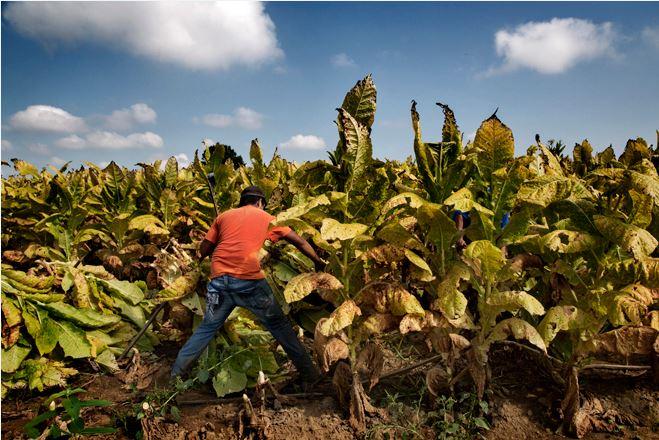
A young farmworker in the US during the tobacco harvest (photo courtesy of Human Rights Watch)
A young farmworker in the US during the tobacco harvest (photo courtesy of Human Rights Watch)

https://stopchildlabor.org/wp-content/uploads/2022/08/logo.png 0 0 Reid Maki https://stopchildlabor.org/wp-content/uploads/2022/08/logo.png Reid Maki2016-06-02 16:27:272022-11-07 06:10:58Tobacco harvester — A five-most-dangerous job for teens
thumbnail

44 Groups Sign-On to CLC Letter Asking Major Tobacco Companies for Better Wages, Collective Bargaining for US Farmworkers and Expansion of the Dunlop Commission Process

May 12, 2015/in In Our Fields, Viewpoints/by Reid Maki

[Child Labor Coalition letter mailed May 4, 2015 to Reynolds American Inc., Phillip Morris International, and British American Tobacco]
On June 24, 2014, a collection of organizations representing millions of Americans, including teachers, healthcare professionals, workers, farmworkers, and advocates concerned about children working in the tobacco fields wrote an open letter to the tobacco industry, outlining a number of steps that must be taken to eliminate child labor from tobacco supply chains.

We are heartened that Reynolds American has expressed interest in implementing stronger policies to end child labor in tobacco fields. However, as we noted in our letter, enacting higher standards is only a portion of the solution. To truly address the problem of child labor in tobacco, effective reporting mechanisms must be established in the fields, and adult workers must receive wages that allow them to support their families and send their children to school rather than work.

This is why we are writing you again, in support of efforts by the Farm Labor Organizing Committee (FLOC) to establish a system for tobacco farm workers in North Carolina to negotiate for better wages, improved working conditions, and establish a committee that can resolve issues for tobacco workers and growers when they arise. We ask that you sign a Memorandum of Understanding (MOU) with FLOC to negotiate recognition of the Dunlop Commission regarding tobacco growers and farmworkers in your supply chain. The Dunlop Commission has been successful in the past in establishing a private system of union recognition and dispute resolution between corporations, growers and workers. The Commission would set out rules and regulations, with participation of all sides, to mediate differences and address the long-term challenges workers and their families face in the tobacco industry. The expansion of the Dunlop Commission proposed by FLOC establishes field-based monitoring and resolution systems for labor rights abuses, including child labor, and makes provisions for remedies when appropriate. This would be an important counterpart to your increased commitments to end child labor.

Tobacco harvesting is hazardous work unsuitable for children, whose bodies and brains are still developing. Research has found that children working in tobacco are especially vulnerable to nicotine poisoning (green tobacco sickness), cancer, health problems from pesticide exposure, injuries from working with dangerous tools and climbing significant heights in curing barns, and respiratory problems from breathing tobacco dust. Most of the workers in the field do not expose their children to these hazards willingly, but out of necessity because of the low wages paid to tobacco harvesters. A 2010 study conducted by Oxfam America found that a quarter of workers surveyed in North Carolina—22 out of 86—were paid less than the federally mandated minimum wage of $7.25 per hour, and 57 workers said that their pay was not enough to meet their basic needs. Furthermore, it found that tobacco pricing mechanisms made it difficult for growers to provide adequately for field workers.

While training, education, regulations, and standards are all important pieces to solve problems in the tobacco supply chain, we believe that higher wages and improved working conditions obtained through a collective bargaining process are critical elements to a solution that leads to the elimination of child labor. Guaranteed the right to negotiate directly to improve conditions in the fields, farmworkers will be able to engage with the appropriate parties to be part of the solution to address labor issues. This approach will provide much more sustainable changes than any top-down approach and empower tobacco growing communities to address the root causes of child labor.

With this in mind, we urge you to boost your efforts to combat child labor by signing an agreement with FLOC to participate in the Dunlop Commission process. The Child Labor Coalition (CLC), its 35 members, and the additional 44 groups that have signed on in support of this letter await a positive response and will continue to be in contact until this issue is resolved. You can reach Reid Maki, CLC coordinator, at 202-207-2820 if you would like to discuss this letter and our support for the farmworker efforts.
Sincerely,

1.            9to52.            American Federation of Labor and Congress of Industrial Organizations (AFL-CIO)

3.            American Federation of Teachers

4.            Association of Farmworker Opportunity Programs

5.            Beyond Borders

6.            California Institute for Rural Studies

7.            Catholic Migrant Farmworker Network

8.            Center for Latino Progress

9.            Delaware Ecumenical Council on Children and Families

10.         Disciples Home Missions

11.         Disciples Refugee and Immigration Ministries

12.         Disciples Women

13.         Dominicans Sisters and Associates of Peace

14.         El Comite de Apoyo a Los Trabajadores Agricolas

15.         Farm Worker Ministry – NorthWest

16.         Farmworker Association of Florida

17.         Farmworker Justice

18.         Food Chain Workers Alliance

19.         Free The Slaves

20.         International Brotherhood of the Teamsters

21.         International Labor Rights Forum

22.         Jobs with Justice

23.         Latino Advocacy Coalition of Henderson County

24.         League of United Latin American Citizens

25.         Lorretto Community

26.         Massachusetts Coalition for Occupational Safety & Health

27.         Media Voices for Children

28.         Migrant Clinicians Network

29.         National Consumers League

30.         National Education Association

31.         National Farm Worker Ministry

32.         Oxfam America

33.         Presbyterian Church (U.S.A)

34.         Puente de la Costa Sur

35.         Sisters of Charity of Nazareth Western Province Leadership

36.         Sisters of Charity of the Blessed Virgin Mary, Dubuque, Iowa

37.         The Episcopal Church

38.         The Ramsay Merriam Fund

39.         The United Methodist Church – General Board of Church and Society

40.         United Church of Christ Justice and Witness Ministries

41.         United Food & Commercial Workers International Union

42.         United Mine Workers of America

43.         West Hills Friends Church (Quaker)

44.         Youth and Young Adult Network of the National Farm Worker Ministry

https://stopchildlabor.org/wp-content/uploads/2022/08/logo.png 0 0 Reid Maki https://stopchildlabor.org/wp-content/uploads/2022/08/logo.png Reid Maki2015-05-12 09:46:152022-11-07 06:10:4944 Groups Sign-On to CLC Letter Asking Major Tobacco Companies for Better Wages, Collective Bargaining for US Farmworkers and Expansion of the Dunlop Commission Process
thumbnail

CLC-Member Human Rights Watch: No Virginia, Tobacco Fields are Not a Place for Children

February 6, 2015/in Children in Agriculture, Children in the Fields Campaign, Viewpoints/by CLC Member

By Zama Coursen-Neff, Human Rights Watch

zama“Are you saying my parents were stupid?”

From Virginia lawmaker Jonny Joannou, it seemed like a reasonable question. If working on the tobacco farm as a child was fine for many Virginians, why should the state ban it now?

The moment came during a committee hearing of the Virginia House of Delegates I attended Tuesday on abill, introduced by Delegate Alfonso Lopez, that would make it illegal to hire children under 18 to work in direct contact with tobacco, unless the child’s parent or grandparent owned the farm. I was there to support the restrictions based on Human Rights Watch’s extensiveresearch on the topic. At the moment, the state’s child labor law, like federal law, exempts child farm workers from the protections enjoyed by all other children who work.

Still, the lawmaker’s question is one I wrestle with. My grandfather grew up working on a farm in Texas, and my dad worked construction in Louisiana at age 12.Now I’m fighting to stop children from doing dangerous jobs, including on tobacco farms where they risk poisoning by nicotine and pesticides. Am I shaming my grandfather and the millions like him who have sent children to work?

If Joannou had directed his question to me, this is what I would have said:

I like to think our parents tried to do what’s best. Children—when they are old enough—can gain valuable skills and work ethic from jobs that are safe and don’t interfere with their education. I want this for my kids, too.

But we now know things our parents didn’t – about car seats, lead-free paint, folic acid, and of course cigarettes. When it comes to child labor, we also know more now about the effect pesticides used on tobacco—many of which are known neurotoxins—have on children’s still-developing bodies. While the long-term effects of nicotine absorption through the skin have not been studied, a recent US Surgeon General’s report suggests that nicotine exposure during adolescence may have lasting consequences for brain development. Almost two-thirds of the more than 140 child tobacco workers we interviewed reported suddenly becoming ill at work with vomiting and nausea, dizziness, difficulty breathing and other symptoms consistent with acute nicotine poisoning.

The House committee swiftly killed the bill, leaving Virginia’s 12-year-olds free to work unlimited hours on tobacco farms in the state this summer. Afterwards, Joannou admitted that he hadn’t worked on a farm as a child, although he did wash dishes in a family-owned restaurant.

I don’t think that real-life farmworker parents—many of whom are desperately poor and largely uninformed about risks in the field—are “stupid” for sending their children to do work that is currently absolutely legal.  But I don’t think it’s smart for legislators to ignore the best evidence we have now on the risks faced by children working tobacco.


https://stopchildlabor.org/wp-content/uploads/2022/08/logo.png 0 0 CLC Member https://stopchildlabor.org/wp-content/uploads/2022/08/logo.png CLC Member2015-02-06 13:31:062022-11-07 06:10:49CLC-Member Human Rights Watch: No Virginia, Tobacco Fields are Not a Place for Children
Page 2 of 3123

Pages

  • About Us
  • Coalition Leadership
  • Coalition Members
  • Contact Us
  • Donate
  • Giving Tuesday 24
  • Home
  • Home-dev
  • Home-dev-new
  • Our History
  • Our Mission, Objectives & Endorsed Bills

Categories

  • 10 Facts About…
  • Afghan Bacha Bazi Trafficking Action
  • Afghanistan
  • African Countries
  • Agriculture
  • Angola
  • Bangladesh
  • Beedi
  • Bolivia
  • Botswana
  • Brazil
  • Bricks
  • Burkina Faso
  • Burma/Myanmar
  • Cambodia
  • CARE Act
  • Central African Republic
  • Chad
  • Child Labor – International
  • Child Labor – US
  • Child Labor Maps & Infographics
  • Child Labor Programs in Danger
  • Child Labor Stats
  • Child Labor Tools for Consumers–Apps
  • Child Soldiers
  • Children in Agriculture
  • Children in the Fields Campaign
  • Chile
  • China
  • Chocolate
  • Chocolate
  • Clothes
  • Clothing
  • Colombia
  • Construction
  • Convention on the Rights of the Child
  • Corporations and Child Labor
  • Cote d'Ivoire
  • Cotton
  • Cotton
  • Countries
  • Democratic Republic of the Congo (DRC)
  • Domestic Workers/Household Servants
  • Donate
  • Education & Child Labor
  • Egypt
  • El Salvador
  • Electronic Equipment
  • Electronics
  • Enforcement–US
  • Ethiopia
  • Fast Facts
  • Fast Food
  • Federal Laws
  • Forced Labor/Slavery
  • Ghana
  • Global Campaign for Education
  • Gold
  • Help Us End Child Slavery!
  • In Our Fields
  • In Our Products
  • India
  • Industry/Products
  • International Initiatives
  • Jordan
  • Kazakhstan
  • Kenya
  • Laos
  • Legislation
  • Lesotho
  • Liberia
  • Links
  • Madagascar
  • Malawi
  • Mexico
  • Mining
  • Mozambique
  • Namibia
  • News & Events
  • News & Resources
  • Niger
  • Nigeria
  • Other Products
  • Pakistan
  • Peru
  • Philippines
  • Press Releases
  • Reports
  • Rubber
  • Rugs
  • Rwanda
  • Saudi Arabia
  • Seafood
  • Soccer Balls
  • Somalia
  • State Laws
  • Street Vending
  • Sudan
  • Take Action
  • Thailand
  • Timeline
  • Tin
  • Trafficking (International)
  • Trafficking–US
  • Turkey
  • U.S. DOL
  • Uncategorized
  • US Campaigns
  • US Child Labor Laws
  • Uzbekistan
  • Vanilla
  • Vietnam
  • Viewpoints
  • Voices — Podcasts, Radio Shows, and Television
  • Yemen
  • Young Worker Deaths & Injuries
  • Youth Employment
  • Youth Peddling Crews
  • Zambia
  • Zimbabwe

Archive

  • June 2026
  • May 2026
  • March 2026
  • February 2026
  • January 2026
  • December 2025
  • November 2025
  • October 2025
  • August 2025
  • July 2025
  • June 2025
  • May 2025
  • April 2025
  • February 2025
  • January 2025
  • October 2024
  • July 2024
  • June 2024
  • May 2024
  • April 2024
  • March 2024
  • February 2024
  • December 2023
  • November 2023
  • October 2023
  • August 2023
  • July 2023
  • June 2023
  • May 2023
  • April 2023
  • March 2023
  • February 2023
  • August 2022
  • June 2022
  • May 2022
  • April 2022
  • March 2022
  • February 2022
  • January 2022
  • October 2021
  • July 2021
  • June 2021
  • May 2021
  • April 2021
  • March 2021
  • February 2021
  • December 2020
  • October 2020
  • September 2020
  • August 2020
  • June 2020
  • May 2020
  • March 2020
  • December 2019
  • November 2019
  • August 2019
  • June 2019
  • April 2019
  • December 2018
  • November 2018
  • September 2018
  • July 2018
  • May 2018
  • April 2018
  • March 2018
  • February 2018
  • December 2017
  • September 2017
  • July 2017
  • June 2017
  • April 2017
  • November 2016
  • October 2016
  • September 2016
  • August 2016
  • July 2016
  • June 2016
  • May 2016
  • April 2016
  • February 2016
  • January 2016
  • December 2015
  • November 2015
  • October 2015
  • August 2015
  • June 2015
  • May 2015
  • March 2015
  • February 2015
  • January 2015
  • November 2014
  • October 2014
  • August 2014
  • July 2014
  • June 2014
  • April 2014
  • February 2014
  • January 2014
  • December 2013
  • November 2013
  • October 2013
  • September 2013
  • August 2013
  • July 2013
  • June 2013
  • May 2013
  • March 2013
  • February 2013
  • January 2013
  • December 2012
  • November 2012
  • October 2012
  • September 2012
  • August 2012
  • July 2012
  • June 2012
  • May 2012
  • April 2012
  • March 2012
  • February 2012
  • January 2012
  • December 2011
  • November 2011
  • October 2011
  • September 2011
  • August 2011
  • July 2011
  • June 2011
  • May 2011
  • April 2011
  • March 2011
  • February 2011
  • January 2011
  • December 2010
  • November 2010
  • October 2010
  • September 2010
  • August 2010
  • July 2010
  • June 2010
  • May 2010
  • April 2010
  • March 2010
  • February 2010
  • September 2009
  • July 2009
  • June 2009
  • May 2008
  • November 2007
  • June 2007
  • July 1881
  • July 1876
  • July 1842
  • July 1836
  • January 1832

CLC members—the Ramsay Merriam Fund, the American Federation of Teachers, and the National Education Association—made this web site possible through their generous support.

Quick Links

Useful Links

Contact Us

  • National Consumers League
    1701 K Street, N.W., Suite 1200
    Washington, DC 20006

  • childlaborcoalition@nclnet.org

© Copyright 2026 - stopchildlabor
Scroll to top
Twitter – Check out the CLC’s Twitter stream YouTube – check out child labor videos on the CLC YouTube channel