thumbnail

119th Congressional Bills endorsed by the Child Labor Coalition:


The Child Labor Coalition, comprised of 38 organizational members, endorses the following child labor bills in the 119th Congress:


Protecting child farmworkers:


  • R. 3335 – “Children Don’t Belong on Tobacco Farms Act by Rep. DeLauro” (D-CT)

62 cosponsors as of 3/30/2026

This bill bans direct contact with toxic tobacco on U.S. farms for minors.


  • 1742 – “Children Don’t Belong on Tobacco Farms Act” by Senator Durbin (D-IL)

4 cosponsors as of 3/30/2026

This bill bans direct contact with toxic tobacco on U.S. farms for minors.


  • R. 6066 –“Children’s Act for Responsible Employment and Farm Safety — CARE Act” by Rep. Ruiz (D-CA)

6 cosponsors in the 119th as of 3/30/2026

[A Senate introduction by Lujan expected soon in the 119th]

The bill raises the base age of farmwork from 12 to 14 and minimum age of hazardous farm work from 16 to 18 – the same as all other sectors. The bill does not apply to farm kids working on their family farm.


Bills to increase fines:

  • “Justice for Exploited Children Act of 2023” by Rep. Scholten (D-MI)

8 cosponsors in the 119th as of 3/30/2026

Raise child labor fines and criminal penalties substantially.


Bills that seek increased fines AND multiple other improvements:


Has 8 cosponsors as of 3/30/2026.

Raises child labor fines by a factor of 10, sets minimum fines, and enhances criminal penalties. It would establish a National Advisory Committee on child labor and foster interagency collaboration to combat child labor. It would call for the periodic review of hazardous work rules for children.


79 cosponsors in the 119th on 3/30/2026.

Would raise child labor fines by a factor of 10. Would improve record keeping requirements for employer to help labor law enforcement.


  • R. 7002 “Justice for Exploited Children Act” by Rep. Scholten (D- MI)

Has 8 cosponsors on 3/19.2026. The bill is bipartisan (Rep. Ryan Mackenzie (D-PA).

Increases child labor fines and criminal penalties substantially.


Federal Procurement Bills regarding child labor:

  • 920 – “Preventing Child Labor Exploitation Act” by Senator Josh Hawley R-MO.

1 cosponsor as of 3/19/2026.

[This bill is bipartisan – Sen. Booker is the other lead]

The bill bars companies that have repeat child labor violations from selling goods to the U.S. government.


We urge congressional members to join the Congressional Child Labor Prevention Task Force, which is led by Rep. Scholten (D-MI) and Rep. McGarvey (D-KY).


Staffers, please let us know when your office introduces a child-labor related bill. Email info to Reid Maki at reidm@nclnet.org or call 202-207-2820.


The Child Labor Coalition congressional champions from the 118th Congress:


The Child Labor Coalition represents 38 groups that work collaboratively to reduce child labor.  

thumbnail

Representing survivor voices at the Sixth Global Conference on the Elimination of Child Labor (by a young survivor of child labor)

March 8, 2026

By Sumitra Basnet

There was a time in my life when work filled my days, and school felt out of reach. I entered the carpet industry as a young child because my family could not afford my education. I learned too early what it meant to carry responsibilities no child should have to bear.

Posing in front of the Palais des Congrès in Marrakech, Morocco, where the Sixth Global Conference on the Elimination of Child Labour is being held.
 

This February, I carried those experiences with me to the Sixth Global Conference on the Elimination of Child Labour in Marrakech, Morocco, where I took part not only as an attendee, but as a survivor and advocate.

Getting a visa as a young woman from a developing country like Nepal was not easy. The process was challenging, but with the encouragement and support of people I have come to know along the way, I was finally able to make the journey.

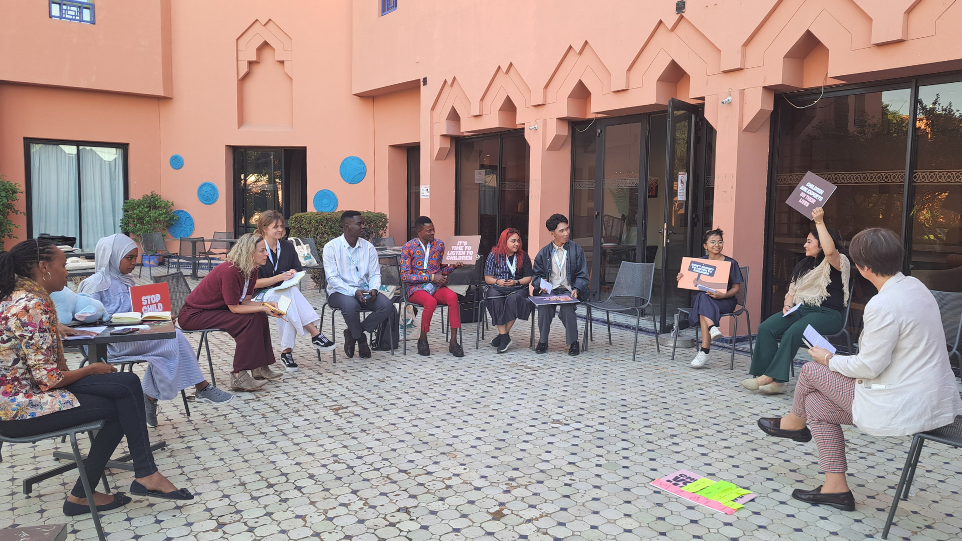
This was not just an international event. It was a once-in-a-lifetime opportunity to represent the voices of child labor survivors on a global stage. The conference, held from February 11–13 at the Palais des Congrès, brought together governments, civil society, businesses, and survivors from around the world. Sitting in a room with representatives from 187 International Labour Organization member states made it clear how serious and widespread the issue of child labor still is.


CAPTION.


Side event display, highlighting a panel discussion with survivors and youth in which I am participating at the Sixth Global Conference on the Elimination of Child Labour in Marrakech, Morocco.
 

CAPTION


With Sadikshya Nepal, GoodWeave’s Director of Communications and Advocacy, and representatives from Nepal’s Ministry of Labour, Employment and Social Security (MOLESS) at the Sixth Global Conference on the Elimination of Child Labour in Marrakech, Morocco.
 

On February 12, I had the honor of speaking on a panel alongside fellow survivors from Ghana, Kenya, the Philippines, the United States, and Morocco. Sharing our lived experience was powerful. It reminded everyone that child labor is not just a statistic, but something that affects millions of children every day globally.

Child labor in Nepal often means children under 14 working in hazardous industries such as carpet factories, brick kilns, agriculture, and domestic work. For many of them, school is not an option. Poverty, climate change, migration, debt, disability, and alcoholism can make these situations even more difficult for families.

In my own case, poverty led me to start working in a carpet factory at the age of nine. In the factory, we used to work from 5:00 am to 10:00 pm. I remember watching other children go to school and wishing I could join them. Some children lived under the contractors’ care, especially girls who were particularly vulnerable. There was limited drinking water, poor sanitation, no proper winter clothing, and long, exhausting hours. We would sometimes comfort ourselves by believing that a better life was not meant for us.

CAPTION


Participating in a discussion with youth and child labor survivors, where we share experiences and reflect on ways to strengthen efforts to end child labor. This is a side event part of the Sixth Global Conference on the Elimination of Child Labour in Marrakech, Morocco.
 

During the panel, I emphasized the importance of youth leadership and collective action. I spoke about how young people are not only ready to lead change but are already driving it forward. I shared examples from Nepal, including youth-led movements that showed the power of young voices demanding accountability. I also spoke about my own efforts, sharing my story in my community to encourage families to send their children to school, and engaging with ethical businesses internationally to promote child-labor-free supply chains.

The practice sessions before the panel helped me prepare and feel confident. This was my second international event after Iceland last year, and this time I felt stronger, more independent, and proud of my growth. Traveling alone and speaking at such a major conference gave me even more confidence in myself.

CAPTION


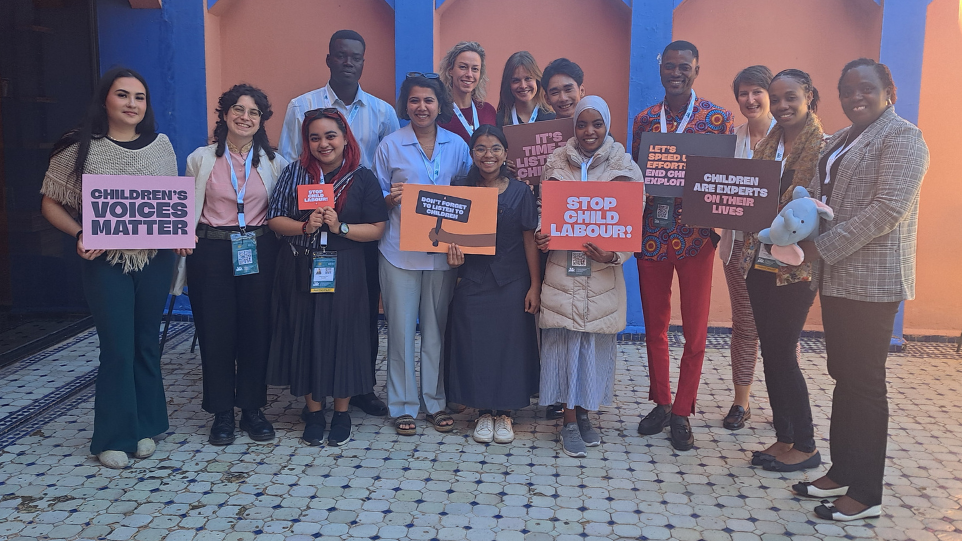
The whole panel group from Kenya, the Philippines, the US, and Nepal, along with organizers from Terre des Hommes and SOS Children’s Villages, after our first practice session.
 

Beyond the panel, the most meaningful part of the conference was connecting with other survivors. Even though we came from different countries, our stories carried similar pain, resilience, and hope. Those connections reminded me that we are not alone in this fight.
This experience reinforced my belief that ending child labor is possible, but only if governments treat it as a top priority and work together with businesses, civil society, and young people.


Survivors should not only be invited to speak. They should also be given a seat at the decision-making table.


TEXT


Admiring the intricate architecture inside a traditional Moroccan building in Marrakech, Morocco.
 

From a girl working in a factory to a young woman speaking at a global conference in Morocco and in Iceland, my journey shows that change is possible. And I will continue raising my voice until every child has the chance to learn, dream, and live freely.

Read more

thumbnail

Press Statement: The Child Labor Coalition is Disappointed Over Indiana Governor Braun’s Signing into Law a Bill That Dismantles the State’s Teen Worker Tracking System

For immediate release: March 10, 2026

Media contact: National Consumers League/Child Labor Coalition Reid Maki, reidm@nclnet.org, (202) 207-2820

Washington, DC—The Child Labor Coalition (CLC), consisting of 38 organizational members who work to end exploitative child labor, is disappointed by Gov. Mike Braun’s signing into law House Bill 1302, which dismantles the state’s system for tracking teen workers.

The Youth Employment System (YES) required companies with five or more teens on the payroll to register their business and self-report the number of minors they had hired and their employment status, as well as other details. It follows Indiana’s unfortunate decision to eliminate its work permit system in July 2021.

“We believe that eliminating this system compounds the mistake of ending the work permit system,” said Reid Maki, the director of Child Labor Advocacy and the coordinator of the CLC. “In deciding not to track teen workers, Indiana is making child labor enforcement efforts significantly more difficult. Our child labor laws help protect teens from workplace injuries and ensure that their education is not negatively impacted by excessive work hours. We should not be weakening the ability of state inspectors to safeguard kids.”

The CLC sent Gov. Braun an electronic letter urging him to veto HB 1302 on February 27th. In December, the coalition sent Ohio Governor Mike DeWine a letter urging him to veto a bill that would have extended hours for 14- and 15-year-old workers. DeWine vetoed the bill, saying he didn’t see a compelling reason that the state needed to risk the educational success of teen workers. We urged Gov. Braun to put the needs of teen workers first.

Since 2020, Indiana has progressively weakened child labor protections. “The state has eliminated rest breaks for minor workers and extended maximum weekly hours for 16- and 17-year-olds,” noted Maki. “Now, they’ve ended the system that helped state agencies monitor that work for minors was age-appropriate and safe.”

As the Economic Policy Institute has noted, the now moribund employment registration law may have played a role in deterring future, more serious violations.

House Bill 1302 only made tweaks to the YES system when it moved to the Indiana Senate, where Sen. Linda Rogers (R-Granger), the bill’s Senate sponsor and a golf-course owner who employs teens, urged the dismantling of the entire reporting system. Sen. Greg Taylor (D-Indianapolis) was among those who urged a less drastic approach: “There’s another solution to this problem. You don’t eliminate a reporting requirement when it comes to children and labor,” he said.

###

About the Child Labor Coalition
The Child Labor Coalition began advocacy efforts in 1989 and brings together 38 groups including human rights and child rights organizations, unions, farmworker groups and others. The Coalition is chaired by the National Consumers League.