• ABOUT US
  • OUR HISTORY
  • OUR MISSION & OBJECTIVES
  • COALITION MEMBERS
  • COALITION LEADERSHIP
  • CONTACT US
  • RECEIVE UPDATES
Stop Child Labor - The Child Labor Coalition
  • NEWS & RESOURCES
    • Viewpoints
    • News & Events
    • 10 Facts About…
    • Reports
    • Timeline
    • Social Media
  • CHILD LABOR – US
    • In Our Products
      • Chocolate
      • Cotton
      • Clothes
      • Electronics
      • Gold
      • Tin
    • In Our Fields
      • Children in Agriculture
      • Children in the Fields Campaign
      • CARE Act
    • Legislation
    • Youth Employment
      • Young Worker Deaths & Injuries
      • Youth Peddling Crews
    • Enforcement–US
    • Trafficking–US
    • U.S. DOL
    • US Child Labor Laws
      • Federal Laws
      • State Laws
    • Corporations and Child Labor
    • US Campaigns
  • CHILD LABOR – INTERNATIONAL
    • Agriculture
      • Chocolate
      • Cotton
      • Tobacco
    • Industry/Products
      • Clothing
      • Construction
      • Electronic Equipment
      • Mining
      • Other Products
      • Rubber
      • Rugs
      • Seafood
      • Soccer Balls
      • Tobacco
    • Countries
      • African Countries
      • Angola
      • Botswana
      • Burkina Faso
      • Central African Republic
      • Chad
      • Cote d’Ivoire
      • Democratic Republic of the Congo (DRC)
      • Egypt
    • Child Soldiers
    • Trafficking (International)
    • Forced Labor/Slavery
    • Education & Child Labor
    • International Initiatives
      • Convention on the Rights of the Child
      • Global Campaign for Education
  • TAKE ACTION
    • Donate
    • Child Labor Tools for Consumers–Apps
  • DONATE
  • Search
  • Menu Menu
thumbnail

Progress at Risk as Global Leaders Confront the Ongoing Child Labor Crisis — a Blog by Reid Maki

February 25, 2026/in Child Labor - International, News & Events, Viewpoints, Voices -- Podcasts, Radio Shows, and Television/by Reid Maki

February 12, 2026

By Reid Maki, NCL Director of Child Labor Advocacy & Coordinator of the Child Labor Coalition

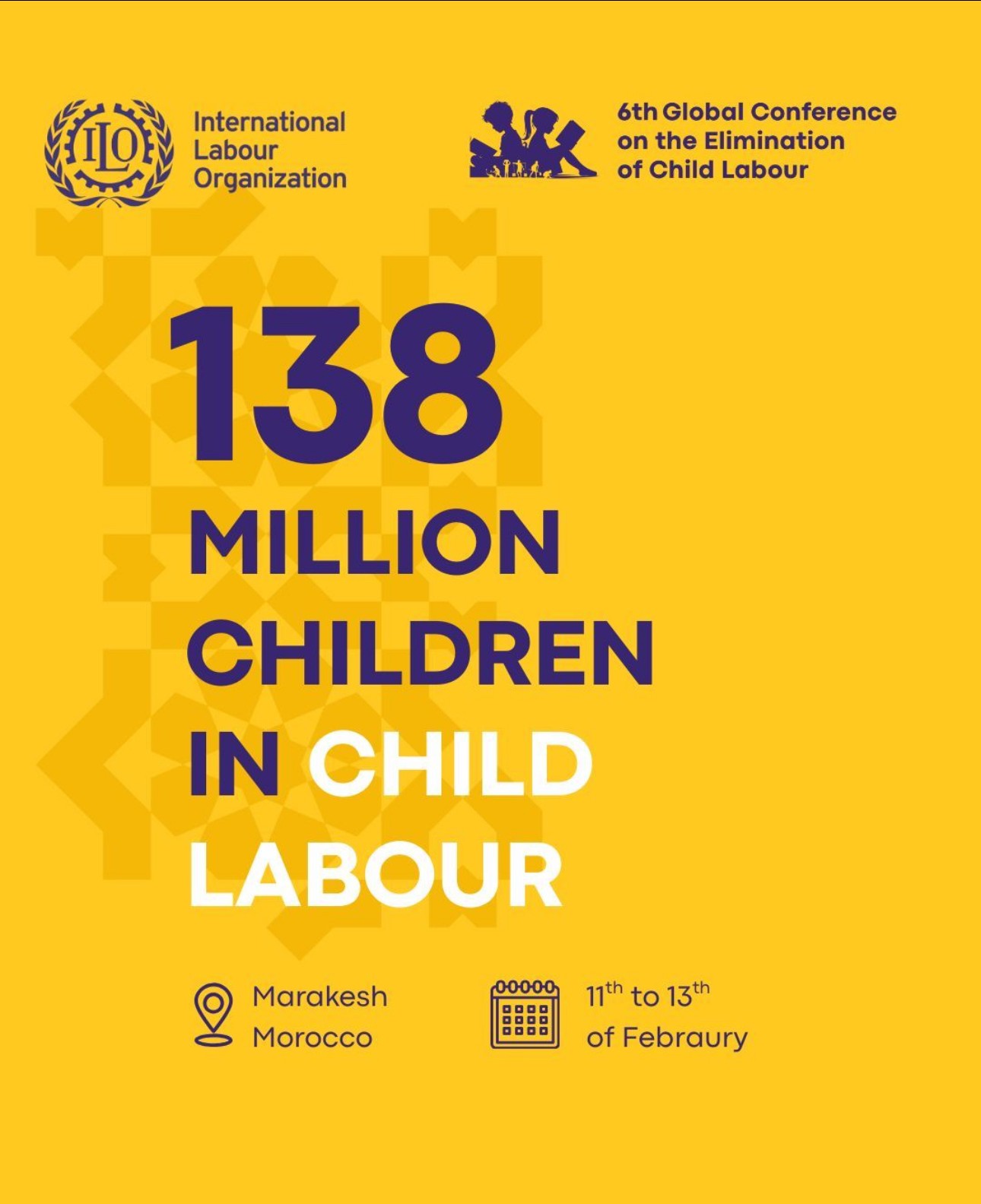
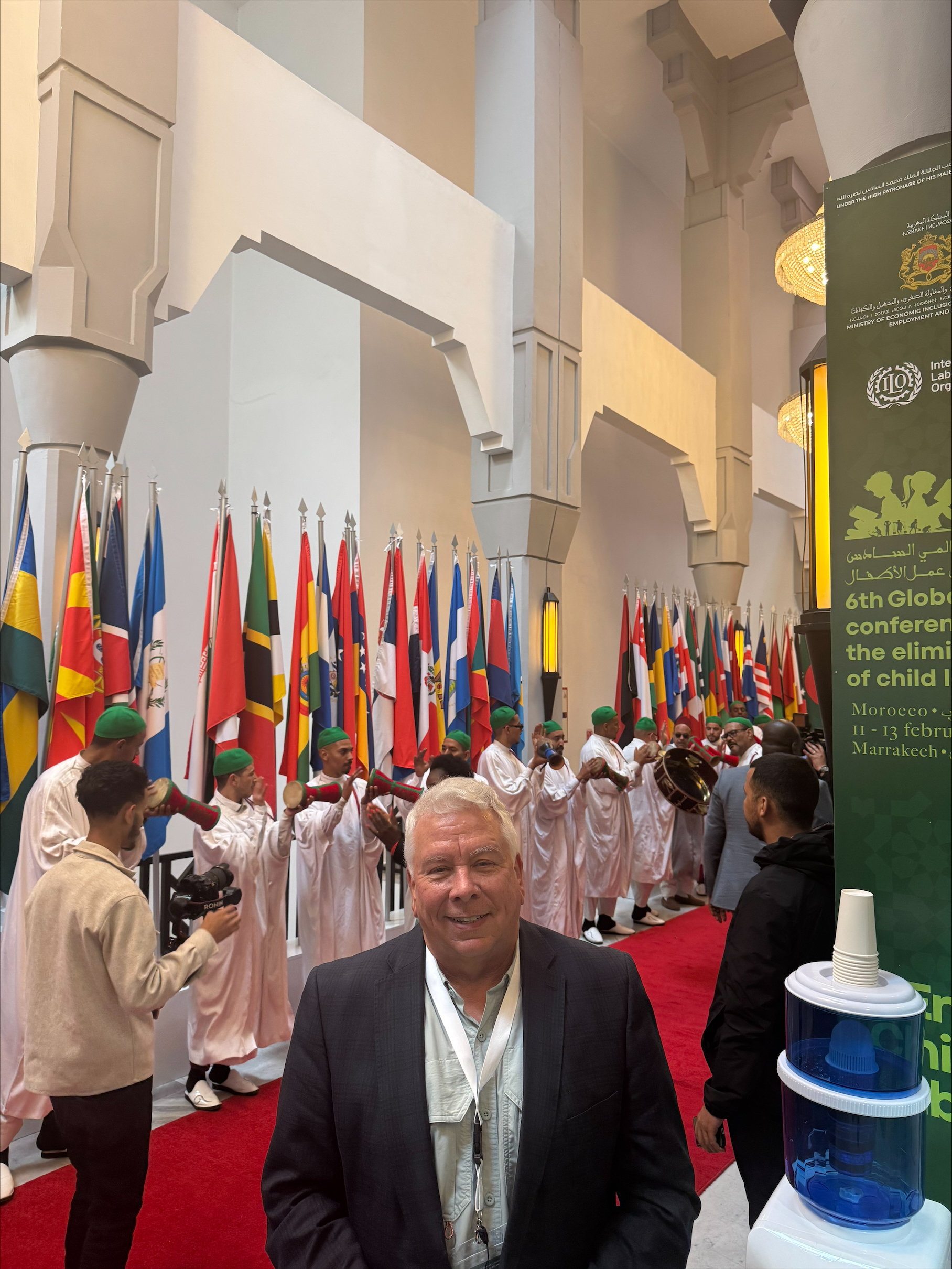
In Marrakech, Morocco, on Wednesday morning, the 6th Global Conference on the Elimination of Child Labour opened at the Palais des Congrès to a palpable air of excitement.

About 1,300 government leaders, employer groups, union leaders, and advocates against child labor attended the conference, organized by the government of Morocco with logistical assistance from the International Labour Organization (ILO). It is the first such international child labor conference since the one held in Durban, South Africa, in May of 2022.

As the Director of Child Labor Advocacy for the National Consumers League and the coordinator of the Child

Labor Coalition, this is my fourth quadrennial global child labor conference. Wednesday’s opening plenary began with a status check, highlighting the remarkable progress in reducing child labor, with estimates dropping from 246 million to 138

million last year. That’s phenomenal progress, but uncertainty hung in the air about what the future holds. The Trump administration’s cancellation of US AID poverty-reduction programs and $550 million in cuts to child labor and labor grants administered by the U.S. Department of Labor International Affairs Bureau in early 2025 has been an ongoing concern for child labor advocates, who fear a reversal of progress toward eliminating child labor.

Despite progress, advocates stressed the unfinished work: the global target to eliminate child labor by 2025 was missed, and 138 million children remain affected. As one speaker put it, ‘the number is simply not acceptable.’

Both the morning and afternoon plenaries featured ministers from several governments, ILO officials, and the International Trade Union Confederation discussing progress and future directions. Participants highlighted that reductions in child labor occurred across all continents where it was prevalent. The largest decrease was a 43% drop in Asia. Globally, the number of children in hazardous child labor fell from 79 million in 2020 to 54 million in 2024. However, speakers also noted a troubling rise in the proportion of child laborers who are between five and eleven years old.

Speakers urged identifying gaps in current efforts and emphasized the need to expand effective remediation—underscoring a united call to action.

Nobel Peace Prize Laureate Kailash Satyarthi addressed participants via video, urging the world to take “tools and guns out of children’s hands” and replace them with “pens and books.” He warned that recent years have seen a troubling decline in “moral accountability” and called for a “resurgence of compassion,” which he described as the transformative force needed to meet global child labor reduction goals. He also urged the ILO to mobilize heads of state committed to ending child labor into a special task force, aimed at building a stronger and more coherent “framework of action.”

“We must be bold,” said Satyarthi.

The conference continues until Friday afternoon, with officials and advocates sharing the strategies they have found most successful.

[The conference  February 13, 2026].

https://stopchildlabor.org/wp-content/uploads/2022/08/logo.png 0 0 Reid Maki https://stopchildlabor.org/wp-content/uploads/2022/08/logo.png Reid Maki2026-02-25 16:29:472026-02-25 16:29:47Progress at Risk as Global Leaders Confront the Ongoing Child Labor Crisis — a Blog by Reid Maki
thumbnail

“I Was Losing Pieces of My Childhood:” a Former Child Farmworker Urges Action to End Child Labor in a Speech to Be Remembered

February 25, 2026/in Child Labor - US, Children in Agriculture, Children in the Fields Campaign, In Our Fields, Viewpoints, Voices -- Podcasts, Radio Shows, and Television, Youth Employment/by Reid Maki

Jacqueline Aguilar speaking at the Morocco global child labor conference.

By Reid Maki, NCL Director of Child Labor Advocacy & Coordinator of the Child Labor Coalition

The recent 6th Global Conference on the Elimination of Child Labour included high-ranking officials from over 100 governments, the ILO, trade groups, and employer groups. I heard many speeches from child labor experts with decades of experience, but former NCL intern Jacqueline Aguilar, only 23 and a recent college graduate, gave by far the most compelling and poignant remarks. In 2023, Jacky interned for me at the Child Labor Coalition, a program of the National Consumers League.  She came to us through a remarkable program for former Migrant Head Start students led by the National Migrant and Seasonal Head Start Association, a member of the Child Labor Coalition.

Jacky spoke on a panel with a half-dozen government officials and a trade unionist. She recalled her experiences in the United States as a child laborer in agriculture. Members of the Child Labor Coalition are concerned that, in any given year, there may be as many as 300,000 minors working in agriculture. They work legally at tasks most adults cannot do because of gaps in child labor law that apply to agriculture. These exemptions allow children to work unlimited hours in the fields (if they aren’t missing school) beginning at the age of 12.

Jacky spoke from the heart about the impact child labor has had on her life and those of her peers from migrant families. Her remarks reminded us of why we were at the conference and impressed the attendees that we must act urgently to protect the 138 million children trapped in child labor.

Jacky started: “When people hear ‘child labor,’ they imagine something far away. A different country. A different life. But I am standing here to tell you it happened. In our communities. In our fields.”

“My parents worked in the fields every single day to provide for us,” recalled Jacky.  “I remember waiting by the door as a little girl for my dad to come home. When he put his hand on my cheek, I would feel how rough it was: cracked, dry, hardened by the earth. I used to wonder why his hands felt like that. Now I know. Those hands were not meant to be that way. They were shaped by survival.”

“At 11 years old, I stepped into those same fields. 11,” she continued.  “While other kids were worrying about homework or sleepovers, I was waking up at 4:00 in the morning. It was still dark outside…By 5:00 a.m., I was in the lettuce rows. The fields were endless. My hands wrapped around a hoe that felt too heavy for my body. The metal burned my palms. Blisters formed and broke. My feet ached from standing for hours. The morning dew soaked through my shoes, and the cold crawled up my legs.”

“There was no one asking how old I was. No one asking if I was tired. No one asking if I was okay. We had 30 minutes for lunch. 30 minutes sitting in the dirt. No cold water. No shade. Just the understanding that we needed to move faster. I wasn’t building character. I was losing pieces of my childhood.”

Like many farmworker families, Jacky’s was touched by cancer. “My father was diagnosed with lung cancer,” she said. “He had been in agriculture since he was seventeen years old,” she recalled.  “I think about the pesticides he inhaled. The dust that settled deep into his lungs. The chemicals that were part of his everyday air. My mother’s body gave out, too. Years of lifting heavy sacks of potatoes tore her shoulder until she couldn’t lift them anymore. I watched my parents sacrifice their health for us. And when my father had to move three hours away for treatment, I stayed behind. I was still in school. But I worked the potato harvest so we could survive, and I could help support my family. “

Jacky recalled one day in particular: “One morning, it started snowing while we were in the field, and the snow collected on the dirt, on the crops, on our shoulders. My fingers went numb. My socks were soaked. I couldn’t feel my toes. I remember standing there, staring at the ground, silently begging for someone, anyone, to say, ‘Go home.” That’s enough.’ But no one said anything. And that silence… it teaches you something. It teaches you that your pain is normal. That your exhaustion is expected. That your childhood is negotiable. I didn’t lose my childhood in one moment. I lost it in early mornings. In blistered hands. In missed school events. In falling asleep over homework because my body couldn’t take anymore.”

Read more

https://stopchildlabor.org/wp-content/uploads/2022/08/logo.png 0 0 Reid Maki https://stopchildlabor.org/wp-content/uploads/2022/08/logo.png Reid Maki2026-02-25 16:22:362026-02-25 16:24:03“I Was Losing Pieces of My Childhood:” a Former Child Farmworker Urges Action to End Child Labor in a Speech to Be Remembered

“I Was Losing Pieces of My Childhood,” Former Child Farmworker Urges Action to End Child Labor in Speech to Be Remembered

February 24, 2026/in Press Releases/by Lisa McDonald

By Reid Maki, Director of Child Labor Coalition

The recent 6th Global Conference on the Elimination of Child Labour included high-ranking officials from over 100 governments, the ILO, trade groups, and employer groups. I heard many speeches from child labor experts with decades of experience, but former NCL intern Jacqueline Aguilar, only 23 and a recent college graduate, gave by far the most compelling and poignant remarks. In 2023, Jacky interned for me at the Child Labor Coalition, a program of the National Consumers League.  She came to us through a remarkable program for former Migrant Head Start students led by the National Migrant and Seasonal Head Start Association, a member of the Child Labor Coalition.

Jacky spoke on a panel with a half-dozen government officials and a trade unionist. She recalled her experiences in the United States as a child laborer in agriculture. Members of the Child Labor Coalition are concerned that, in any given year, there may be as many as 300,000 minors working in agriculture. They work legally at tasks most adults cannot do because of gaps in child labor law that apply to agriculture. These exemptions allow children to work unlimited hours in the fields (if they aren’t missing school) beginning at the age of 12.

Jacky spoke from the heart about the impact child labor has had on her life and those of her peers from migrant families. Her remarks reminded us of why we were at the conference and impressed the attendees that we must act urgently to protect the 138 million children trapped in child labor.

Jacky started: “When people hear ‘child labor,’ they imagine something far away. A different country. A different life. But I am standing here to tell you it happened. In our communities. In our fields.”

“My parents worked in the fields every single day to provide for us,” recalled Jacky.  “I remember waiting by the door as a little girl for my dad to come home. When he put his hand on my cheek, I would feel how rough it was: cracked, dry, hardened by the earth. I used to wonder why his hands felt like that. Now I know. Those hands were not meant to be that way. They were shaped by survival.”

“At 11 years old, I stepped into those same fields. 11,” she continued.  “While other kids were worrying about homework or sleepovers, I was waking up at 4:00 in the morning. It was still dark outside…By 5:00 a.m., I was in the lettuce rows. The fields were endless. My hands wrapped around a hoe that felt too heavy for my body. The metal burned my palms. Blisters formed and broke. My feet ached from standing for hours. The morning dew soaked through my shoes, and the cold crawled up my legs.”

“There was no one asking how old I was. No one asking if I was tired. No one asking if I was okay. We had 30 minutes for lunch. 30 minutes sitting in the dirt. No cold water. No shade. Just the understanding that we needed to move faster. I wasn’t building character. I was losing pieces of my childhood.”

Like many farmworker families, Jacky’s was touched by cancer. “My father was diagnosed with lung cancer,” she said. “He had been in agriculture since he was seventeen years old,” she recalled.  “I think about the pesticides he inhaled. The dust that settled deep into his lungs. The chemicals that were part of his everyday air. My mother’s body gave out, too. Years of lifting heavy sacks of potatoes tore her shoulder until she couldn’t lift them anymore. I watched my parents sacrifice their health for us. And when my father had to move three hours away for treatment, I stayed behind. I was still in school. But I worked the potato harvest so we could survive, and I could help support my family. “

Jacky recalled one day in particular: “One morning, it started snowing while we were in the field, and the snow collected on the dirt, on the crops, on our shoulders. My fingers went numb. My socks were soaked. I couldn’t feel my toes. I remember standing there, staring at the ground, silently begging for someone, anyone, to say, ‘Go home.” That’s enough.’ But no one said anything. And that silence… it teaches you something. It teaches you that your pain is normal. That your exhaustion is expected. That your childhood is negotiable. I didn’t lose my childhood in one moment. I lost it in early mornings. In blistered hands. In missed school events. In falling asleep over homework because my body couldn’t take anymore.”

Jacky wasn’t alone. She saw other farmworker children suffer. “I watched classmates disappear from school. Smart kids. Funny. Full of light. They didn’t transfer schools. They transferred to full-time labor. And no one called it a crisis,” she recalled.  “No child should have to choose between education and survival. No child should feel responsible for keeping their family afloat. No child should stand in freezing snow waiting for permission to stop working.”

Speaking before an audience of government officials from all over the world, Jacky implored them to do more to end child labor: “To our ministers, policymakers, and public leaders, I am asking you to see us. Strengthen protections for children. A child in a field deserves the same protection as a child anywhere else. Enforce the laws. Visit the fields. Ensure there is clean water, real breaks, and protection from harmful chemicals. Support families with living wages, healthcare, and financial stability so children are not pushed into labor out of desperation. Train schools to recognize working children not as lazy or distracted but as exhausted. And include survivors in your decisions. We know where the system fails because we experienced the failure.”

“I am proud of my parents. I am proud of where I come from. But I should not have had to grow up that fast,” said Jacky. “There are children, right now, standing in rows of crops before the sun rises. Their hands are blistering. Their backs are aching. Their childhood is slipping away quietly. And most people will never know their names. Please do not let their silence continue because child labor does not just take childhoods. It takes futures. And we cannot afford to keep losing them. This happened. I survived it. And I’m not going to whisper about it.”

In three decades of advocacy and four Global Child Labor conferences, I’ve never heard a speech more eloquent or powerful.

Jacky speaks for children in child labor everywhere—not just the 300,000 children who work in agriculture. In recent years, thousands of unaccompanied minors, have come to work in the U.S.  Many ended up working in auto parts factories, the graveyard shifts in meatpacking facilities, or late nights at fast food restaurants. Yet children working in the U.S. are a small fraction of the global reality: 138 million children are engaged in labor worldwide. Jackie Aguilar’s story gives a voice to all of them.

Jacqueline Aguilar is a recent graduate of Adams State University in Colorado, where she lives and works. Jacky interned for the Child Labor Coalition in the summer of 2023 at the National Consumers League.
https://stopchildlabor.org/wp-content/uploads/2022/08/maki.jpg 92 92 Lisa McDonald https://stopchildlabor.org/wp-content/uploads/2022/08/logo.png Lisa McDonald2026-02-24 21:20:152026-02-24 21:31:00“I Was Losing Pieces of My Childhood,” Former Child Farmworker Urges Action to End Child Labor in Speech to Be Remembered

Pages

  • About Us
  • Coalition Leadership
  • Coalition Members
  • Contact Us
  • Donate
  • Giving Tuesday 24
  • Home
  • Home-dev
  • Home-dev-new
  • Our History
  • Our Mission & Objectives

Categories

  • 10 Facts About…
  • Afghan Bacha Bazi Trafficking Action
  • Afghanistan
  • African Countries
  • Agriculture
  • Angola
  • Bangladesh
  • Beedi
  • Bolivia
  • Botswana
  • Brazil
  • Bricks
  • Burkina Faso
  • Burma/Myanmar
  • Cambodia
  • CARE Act
  • Central African Republic
  • Chad
  • Child Labor – International
  • Child Labor – US
  • Child Labor Maps & Infographics
  • Child Labor Programs in Danger
  • Child Labor Stats
  • Child Labor Tools for Consumers–Apps
  • Child Soldiers
  • Children in Agriculture
  • Children in the Fields Campaign
  • Chile
  • China
  • Chocolate
  • Chocolate
  • Clothes
  • Clothing
  • Colombia
  • Construction
  • Convention on the Rights of the Child
  • Corporations and Child Labor
  • Cote d'Ivoire
  • Cotton
  • Cotton
  • Countries
  • Democratic Republic of the Congo (DRC)
  • Domestic Workers/Household Servants
  • Donate
  • Education & Child Labor
  • Egypt
  • El Salvador
  • Electronic Equipment
  • Electronics
  • Enforcement–US
  • Ethiopia
  • Fast Facts
  • Fast Food
  • Federal Laws
  • Forced Labor/Slavery
  • Ghana
  • Global Campaign for Education
  • Gold
  • Help Us End Child Slavery!
  • In Our Fields
  • In Our Products
  • India
  • Industry/Products
  • International Initiatives
  • Jordan
  • Kazakhstan
  • Kenya
  • Laos
  • Legislation
  • Lesotho
  • Liberia
  • Links
  • Madagascar
  • Malawi
  • Mexico
  • Mining
  • Mozambique
  • Namibia
  • News & Events
  • News & Resources
  • Niger
  • Nigeria
  • Other Products
  • Pakistan
  • Peru
  • Philippines
  • Press Releases
  • Reports
  • Rubber
  • Rugs
  • Rwanda
  • Saudi Arabia
  • Seafood
  • Soccer Balls
  • Somalia
  • State Laws
  • Street Vending
  • Sudan
  • Take Action
  • Thailand
  • Timeline
  • Tin
  • Trafficking (International)
  • Trafficking–US
  • Turkey
  • U.S. DOL
  • Uncategorized
  • US Campaigns
  • US Child Labor Laws
  • Uzbekistan
  • Vanilla
  • Vietnam
  • Viewpoints
  • Voices — Podcasts, Radio Shows, and Television
  • Yemen
  • Young Worker Deaths & Injuries
  • Youth Employment
  • Youth Peddling Crews
  • Zambia
  • Zimbabwe

Archive

  • March 2026
  • February 2026
  • January 2026
  • December 2025
  • November 2025
  • October 2025
  • August 2025
  • July 2025
  • June 2025
  • May 2025
  • April 2025
  • February 2025
  • January 2025
  • October 2024
  • July 2024
  • June 2024
  • May 2024
  • April 2024
  • March 2024
  • February 2024
  • December 2023
  • November 2023
  • October 2023
  • August 2023
  • July 2023
  • June 2023
  • May 2023
  • April 2023
  • March 2023
  • February 2023
  • August 2022
  • June 2022
  • May 2022
  • March 2022
  • February 2022
  • January 2022
  • October 2021
  • July 2021
  • June 2021
  • May 2021
  • April 2021
  • March 2021
  • February 2021
  • December 2020
  • October 2020
  • September 2020
  • August 2020
  • June 2020
  • May 2020
  • March 2020
  • December 2019
  • November 2019
  • August 2019
  • June 2019
  • April 2019
  • December 2018
  • November 2018
  • September 2018
  • July 2018
  • May 2018
  • April 2018
  • March 2018
  • February 2018
  • December 2017
  • September 2017
  • July 2017
  • June 2017
  • April 2017
  • November 2016
  • October 2016
  • September 2016
  • August 2016
  • July 2016
  • June 2016
  • May 2016
  • April 2016
  • February 2016
  • January 2016
  • December 2015
  • November 2015
  • October 2015
  • August 2015
  • June 2015
  • May 2015
  • March 2015
  • February 2015
  • January 2015
  • November 2014
  • October 2014
  • August 2014
  • July 2014
  • June 2014
  • April 2014
  • February 2014
  • January 2014
  • December 2013
  • November 2013
  • October 2013
  • September 2013
  • August 2013
  • July 2013
  • June 2013
  • May 2013
  • March 2013
  • February 2013
  • January 2013
  • December 2012
  • November 2012
  • October 2012
  • September 2012
  • August 2012
  • July 2012
  • June 2012
  • May 2012
  • April 2012
  • March 2012
  • February 2012
  • January 2012
  • December 2011
  • November 2011
  • October 2011
  • September 2011
  • August 2011
  • July 2011
  • June 2011
  • May 2011
  • April 2011
  • March 2011
  • February 2011
  • January 2011
  • December 2010
  • November 2010
  • October 2010
  • September 2010
  • August 2010
  • July 2010
  • June 2010
  • May 2010
  • April 2010
  • March 2010
  • February 2010
  • September 2009
  • July 2009
  • June 2009
  • May 2008
  • November 2007
  • June 2007
  • July 1881
  • July 1876
  • July 1842
  • July 1836
  • January 1832

CLC members—the Ramsay Merriam Fund, the American Federation of Teachers, and the National Education Association—made this web site possible through their generous support.

Quick Links

Useful Links

Contact Us

  • National Consumers League
    1701 K Street, N.W., Suite 1200
    Washington, DC 20006

  • reidm@nclnet.org

© Copyright 2026 - stopchildlabor
Scroll to top
Twitter – Check out the CLC’s Twitter stream YouTube – check out child labor videos on the CLC YouTube channel